

Why Teacher Induction Matters
Donna Hyatt, Ed.D.
Several years ago, I built a teacher induction program, and that experience taught me as much about what not to do as it did about what was possible. And so, when my Gateway Public Schools colleagues and I set out to build Gateway Teacher Induction, our goal was not to create just another program teachers had to get through on the way to their credential. Most new teachers learn this the hard way: the credential that got them into the classroom is not enough to keep them there.
A new teacher walks into their classroom on the first day with a credential in hand and a head full of preparation. What they may not have realized when enrolling in a credential program is that the credential they earned is only the beginning. In 32 states across the country, including California, teachers are required by law to complete a new teacher mentoring program (usually in the first 1-3 years of credentialed teaching). In of those states, teachers must successfully complete this mentoring program to continue teaching. Induction is the name for that program, and while the basic structure may look similar across programs, what teachers experience inside these programs may vary widely. Done well, induction changes how a teacher sees their work. Done poorly, induction becomes just paperwork with a mentor attached.
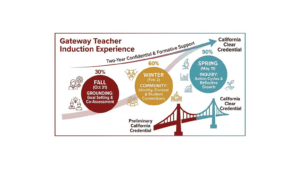
Gateway wanted something genuinely tailored to meeting teachers where they are, built around their specific needs and growth rather than around compliance. Getting there took 18 months of planning and navigating the initial state approval process, and then three more years of piloting, adjusting, and learning. And, at the end of February, Gateway Teacher Induction moved from initial state accreditation to a recommendation for full state accreditation (California), and I want to share what that milestone represents.
Induction done well pairs a new teacher with an experienced mentor who provides sustained, personalized support, who observes their teaching, co-plans lessons with them, digs into student work alongside them, and has the kind of honest, trusting professional conversations that help a teacher figure out not just what to do, but who they are becoming in that classroom. Teachers who receive this kind of mentored support stay in the profession longer, grow faster, and create better outcomes for students. Every new teacher deserves this kind of support from day one of their first year, not from Year 2 or 3 (or, in some cases, Years 4 and 5).
What Gateway set out to build, and what it costs to build it right
Gateway Teacher Induction serves teachers in public charter schools across San Francisco, Oakland, and Hayward, California. These are urban communities where more than 110,000 students show up every day, many of them English Learners, many from under-resourced neighborhoods, all of them deserving teachers who feel genuinely supported in their work.
We built this program because size matters in this work. When a program serves hundreds of teachers across dozens of schools, personalization becomes almost impossible, no matter how committed the people running it are. We wanted to ensure individualized support, site-based mentoring, and a structure small enough to see the whole person. In practice, that means mentors who regularly give double or triple the required hour per week of contact time because they understand what is at stake. It also means support that extends beyond scheduled visits, because when something goes sideways in a classroom or a teacher hits a wall at 9 pm on a Tuesday night, they need someone who can listen and provide guidance and support.
None of this is inexpensive. A quality mentor costs a minimum of $2,500 per candidate per year, and that figure reflects required time only and not the additional hours most committed mentors invest. Mentor training, program oversight, candidate support, and operational costs add significantly to that figure. When induction was first introduced in California roughly 25 years ago, it came with meaningful state funding. That funding has dwindled substantially over time, and some schools and districts do not (or cannot) cover the gap. In California, if a school or district doesn’t cover the cost of induction (or if a teacher wishes to pursue a program outside of that school or district), then the teacher must pay out of pocket.
That is the reality for a lot of new teachers right now, including one I recently connected with.
Meet Emily
Emily is a first-year teacher in San Francisco. She knew she needed induction, so she did what she was supposed to do: she tried to enroll in her local program. It had a waitlist. When a spot opened, she was told she could enroll but would need to find her own mentor. Unfortunately, she could not secure one and has been trying to figure it out on her own ever since.
After learning that The Oaks had a connection to induction support, she reached out, and we met to talk through her options. Emily can enroll in Gateway Induction, but because she would be doing induction outside of her district, she would have to pay for it herself. For a first-year teacher, almost $3,000 out of pocket is not a small ask.
Emily is not an exception. She represents the reality for far too many beginning teachers across California: required by the state to complete induction, trying in good faith to do so, and running into walls that have nothing to do with their commitment or their ability.
What you can do
If you believe that new teachers deserve real support, not just a requirement to fulfill but a genuine investment in their learning and growth and their students’ success, I am asking you to help make that possible. A donation to Earthwise Knowledge Initiative Educator Collaborative (The Oaks’ non-profit fiscal sponsor) supports teachers like Emily so they can enroll in Gateway Induction. Teaching is serious work, and the people just starting out in it deserve serious investment. Please consider helping us keep Emily, and other teachers in her situation, in the teaching profession.
Your donation is tax-deductible and goes directly toward keeping induction accessible to teachers who would otherwise have to pay for it out of pocket. When you support a teacher like Emily, you are not just investing in her. You are investing in every student who will spend a year in her classroom, and every year after that.
About Gateway Teacher Induction

